Information and Olive Oil Insights
What is the difference between Extra Virgin Olive Oil (EVOO) and other types of Olive Oil?
The olive oil is classified depending on the acidity. You need a laboratory analysis and a tasting done by a professional (like a sommelier for wines) to certify the highest quality that is the Extra Virgin Olive Oil (EVOO). To achieve this distinction, you need low acidity (under 0.8% of oleic acid) and a specific flavour to palate and smell. Virgin olive oil ranges between (0.8 - 0.2%).
.jpg/:/cr=t:21.8%25,l:0%25,w:100%25,h:56.39%25/rs=w:400,h:300.7518796992481,cg:true)
Phenols & Oleocanthal What Are They?
When people talk about phenols or oleocanthal, they’re referring to the same thing. It is what makes a vibrant, fresh, antioxidant-rich olive oil stand out.
Phenols are natural compounds found in extra virgin olive oil and are closely linked to quality, freshness, and health benefits. They act as powerful antioxidants, helping protect the body from oxidative stress — one of the key reasons olive oil has been at the heart of Mediterranean diets for centuries. In simple terms, they’re part of what gives great olive oil both its nutritional value and its character.
Their levels are influenced by many factors, including olive variety, harvest timing, climate, and how carefully the oil is produced and handled. Fresher, early harvest oils typically contain higher levels, which is why they often taste more intense and peppery.
One of the most well-known phenols is oleocanthal, which gives high-quality olive oil its distinctive peppery kick at the back of the throat. That gentle “bite” is actually a sign of freshness and high phenolic content, not bitterness. Interestingly, this sensation is so characteristic that it is often used by producers and tasters as a quick indicator of quality and freshness.
Together, phenols — and oleocanthal in particular — are a big part of what separates a standard olive oil from an exceptional one: not just in taste, but in aroma, stability, and overall complexity.

What are Early Harvest Olive Oils?
When people talk about “early harvest” olive oil, they’re usually referring to oils made from olives picked at the start of the season — often around November. These oils tend to be more vibrant, more aromatic, and naturally higher in compounds like phenols.
But “early” isn’t really a fixed date. It changes depending on the olive variety, the microclimate, the altitude, and how the season has unfolded. What’s early in one grove might be mid-season in another.
In the end, it all comes down to the trees. Harvesting happens when the olives are at the right moment of ripeness and quality — not just because the calendar says so.
For farmers, that’s where things get tricky. Picking earlier can mean more intensity, freshness, and character, but also lower yields and less oil. Waiting a bit longer can increase quantity, but you risk losing some of that vibrancy. It’s a constant balancing act each year, and no two harvests are ever quite the same.

How many kg of olives do you need to produce 1litre of olive oil?
To produce 1 litre of olive oil you need to mill 4 to 5kg of olives. But for higher quaiity olive oil (EVOO) you might need to pick between 8 to 10kg of olives. (Remember the last question? -That's why)
And just to let you know, whilst 1litre of water weights 1kg, 1 litre of olive oil weights around 900 grams.
How many varieties of olive trees are there? Why is a single state relevant?
There are over 1000 recognised of olive varieties, also called cultivars which have developed over period of around 6000 years, which results in distinct characteristics, oil yield, taste, and fruit size.
Olive oil made from a single variety is called a monovarietal, or monocultivar olive oil. Blends are crafted using oils from two or more cultivars to achieve consistency at the expense of character.
Single-estate olive oil is crucial for quality, flavor, and transparency because it offers producers control over the growing, harvesting, and pressing, resulting in unique, authentic tastes reflecting specific terroir (soil, climate) and ensuring freshness.
For more information you can visit Olive Oil Times
Our Olive Trees
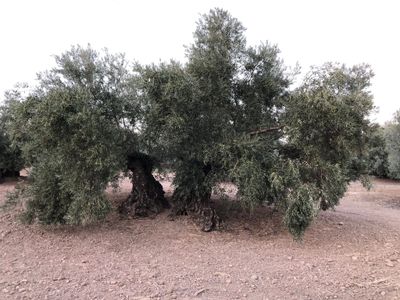
Our Hojiblanca olive trees are the reason for the high quality and fantastic taste of our olive oil. They are predominantly between 100 and 200 years old and possibly older in some instances and represent four generations of careful management by our family.
Our parents, grandparents and great grandparents all walked through the same trees and for that reason they are firmly part of the Cortijo Coracho family.
We have trees with two, three and even some with four legs (trunks) which are fantastically gnarled and twisted. They are planted in the traditional way, with wide spaces between the rows which in the past would have been used to grow crops and graze animals. This wide spacing provides excellent air flow and allows the trees to grow and spread naturally.
The trees are rain fed, which can reduce oil yield but, that along with the age of the trees, provides oil with a fantastic taste which reflects the soil and climate of our farm.
Cortijo ... what does it mean?
Quite a few people have asked what cortijo means, as they have never heard that word before. A cortijo is a traditional farm house in Andalucia and other counties in the South of Spain. Typically they are link ed to olive oil production, cereal and cattle. Some cortijos have a mill to produce olive oil. The mill is called molino or almazara. In Italy, the word used is frantoio. Some cortijos like ours are arranged around a central courtyard and may have a tower which were used keep a watch on the land or for storage.